
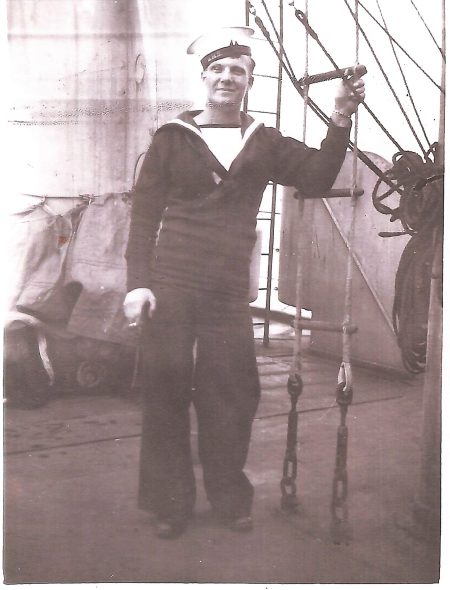
Albert George Druce was a Royal Navy Radar Operator during World War 2.
Albert’s service record shows he served aboard HMS London during the periods 12/2/1941 to 14/12/1941, and from 17/1/1942 to 4/2/1943.
HMS London was a Royal Navy County Type Heavy Cruiser. Its role during the arctic convoys was to provide protective escort for the Allied merchant ships, primarily against attacks by German naval surface vessels. The Germans had a strong naval presence in the Arctic waters at this time, including the heavy battleship Tirpitz. The presence of the Tirpitz was a major concern for Allied commanders due to its potential to inflict heavy damage on Allied ships.
Based on HMS London’s wartime operational records, Albert’s first experience in the Arctic waters would have been on 22nd September 1941 when HMS London was sent to Scapa Flow to pick up Lord Beaverbrook and Mr Averill Harriman (a prominent American businessman) with an Anglo American trade delegation and take them to Archangel for high level discussions with the Russians, arriving in Archangel on 27th September. HMS London began its return journey on 28th September, joining other Allied naval ships to escort returning convoy QP1, arriving back in Scapa Flow on 9th October.
During March and April 1942 HMS London was deployed to join the search for the German battleship Tirpitz, which was posing a major threat to Allied convoys heading to Russia. On 28th April HMS London detached from the search for the Tirpitz in order to join and escort convoy PQ15 to Murmansk, linking up on 30th. On 1st May the convoy was attacked by German bombers, but the early attacks were unsuccessful. HMS London was ordered to detach from PQ15 later that day and return to Scapa Flow in order to carry out protection duties elsewhere in the northern waters. PQ15 went on the suffer further aerial attacks, causing the loss of 3 merchant ships, but some 22 fully laden ships arrived safely in Murmansk which was the largest allied convoy yet to arrive in the Soviet Union.
During late May 1942 HMS London carried out covering escort duty for convoy PQ16 travelling to Murmansk and Archangel, which was the largest convoy yet assembled. It later transferred to returning convoy QP12 which had departed on the same day.
In late June 1942 HMS London was part of the Allied naval escort group for convoy PQ17 heading for Archangel, and was due to pick up returning convoy QP13 on its return journey. Convoy PQ17 became infamous for the wrong reasons. It came under sustained German attacks by German bombers and U-boat torpedoes, suffering heavy losses.
Allied commanders became concerned the convoy would be attacked by German surface ships including the heavy battleship Tirpitz. Intelligence reports suggested the Tirpitz group was sailing to intercept the convoy. The Admiralty ordered the escorts to head westwards to try to head-off the German surface ships and the merchant convoy was ordered to scatter and make their own way to Russia.
The information of impending attack from the Tirpitz group turned out to be incorrect. HMS London returned to Iceland on 4th July. The order for the convoy to scatter left the merchant ships largely undefended. Only 11 out of the original 35 supply ships in the convoy reached Archangel. The other 24 ships were sunk by the German attacks.
HMS London returned to Russia again in 1942, departing Loch Ewe 12th September, escorting convoy PQ18 as far as the Kola Inlet, returning to Home Fleet interception duty on 18th. As a result of what happened to convoy PQ17, PQ18 was given a much stronger naval escort. Although the convoy was subjected to sustained attacks from German bombers and U-boats and a number of ships were lost, the majority did make it safely through to their destination.
From the information shared with the Arctic Convoys Museum about Albert’s time in the Royal Navy, he went on to serve on other ships after his time on HMS London, crossing the Atlantic to North America and South America.
Albert had an interest in model making. After the war he made wooden models of HMS London and HMS Liberty, carving the hull from a block of wood and adding the various fitments from other pieces he made or managed to source. They were proudly put on display in the family home.
Albert was a member of the Royal Navy Algerines Association.
[written for ACM by Brian Green]