
[by volunteer Nick Jones]
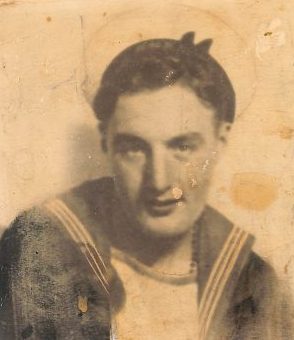
Albert Edward Wait was born in Leicester on 15 May 1925 and volunteered for the Royal Navy before his eighteenth birthday. Like thousands of young men of his generation, he left civilian life to answer his country’s call during the Second World War. Before enlisting he worked as a light lorry driver and, on 15 February 1943, entered naval service with the Chatham Division as Ordinary Seaman JX407939. His service papers recorded him as being five feet six inches tall, with brown hair and blue eyes, and a member of the Church of England.
Albert began his naval career at HMS Ganges, the Royal Navy’s New Entry Training Establishment at Shotley Gate in Suffolk. There, alongside thousands of other wartime volunteers, he underwent the intensive training that transformed civilians into sailors. His instruction would have included naval discipline and customs, seamanship, ropework and knots, boat handling, physical training, swimming, firefighting, damage control, rifle drill, ship and aircraft recognition, signalling, and the routines of life at sea. During the war he also passed through the shore establishments HMS Pembroke, HMS Victory, HMS Naden, HMS Dungeness and HMS Orlando. These “stone frigates” served as administrative and drafting establishments where sailors received refresher instruction, medical examinations, equipment, leave, personnel processing and, ultimately, demobilisation following the end of the war.
Following his recruit training and a series of drafting appointments through HMS Pembroke, Albert joined the King George V-class battleship HMS Anson on 25 May 1943. Serving first as an Ordinary Seaman and, from 15 February 1944, as an Able Seaman, he remained aboard until 29 July 1944. HMS Anson formed part of the Home Fleet, protecting the vital Arctic convoys and covering offensive operations against German naval forces operating from occupied Norway.
While serving in HMS Anson, Albert took part in Operation Leader in October 1943, when the American aircraft carrier USS Ranger launched air strikes against German shipping along the Norwegian coast under the protection of heavy British warships including HMS Anson and HMS Duke of York. In February 1944 he participated in Operation Bayleaf, covering further carrier strikes against German targets in Norway, before taking part in Operation Tungsten on 3 April 1944, the highly successful Fleet Air Arm attack that severely damaged the German battleship Tirpitz. During that operation HMS Anson served as the flagship of Vice Admiral Sir Henry Moore.
After a short return to HMS Pembroke, Albert joined the O-class destroyer HMS Orwell on 11 September 1944. Here he served through the final and demanding months of the Arctic campaign.
Aboard HMS Orwell, Albert escorted Convoys JW61 and RA61 during October and November 1944, followed by Convoys JW62 and RA62 in December. In January 1945 HMS Orwell took part in Operation Spellbinder, a combined offensive against German shipping off the Norwegian coast. During the operation British forces attacked an enemy convoy near Egersund, damaging merchant vessels and sinking the German minesweeper M-273 while successfully repelling submarine and air attacks.
In February 1945 HMS Orwell escorted Convoys JW64 and RA64 through heavy enemy air and submarine attacks in Arctic waters. She continued escort duties with Convoys JW65 and RA65 in March before participating in Operation Trammel in April, laying deep defensive minefields near the Kola Inlet approaches to Murmansk to protect the final Arctic convoys from German U-boats. Albert subsequently served with the escort forces supporting Convoys JW66 and RA66 during the closing weeks of the war in Europe.
Leaving HMS Orwell on 31 May 1945, Albert passed through HMS Victory before serving at HMS Naden, HMS Dungeness and HMS Orlando. During the final year of his naval service he completed the administrative and resettlement process common to many returning wartime sailors before leaving the Royal Navy on 4 June 1946.
Following his naval service, Albert joined the 5th Battalion of the Royal Leicestershire Regiment in the Territorial Army, serving as Private A. E. Wait (Service Number 22220182).
Albert later married Eileen Mary Wait. He died on 28 October 1988, aged sixty-three. During more than three years of wartime service he served in one of the Royal Navy’s newest battleships and one of its hard-worked Arctic destroyers, taking part in the campaign against the German battleship Tirpitz, five Arctic convoy cycles (JW61/RA61, JW62/RA62, JW64/RA64, JW65/RA65 and JW66/RA66), and repeated offensive sweeps off occupied Norway. His service reflected the courage, endurance and professionalism of the young sailors whose efforts helped secure victory in the Arctic and North Atlantic, ensuring that vital supplies reached the Soviet Union during one of the Second World War’s longest and most dangerous campaigns.