
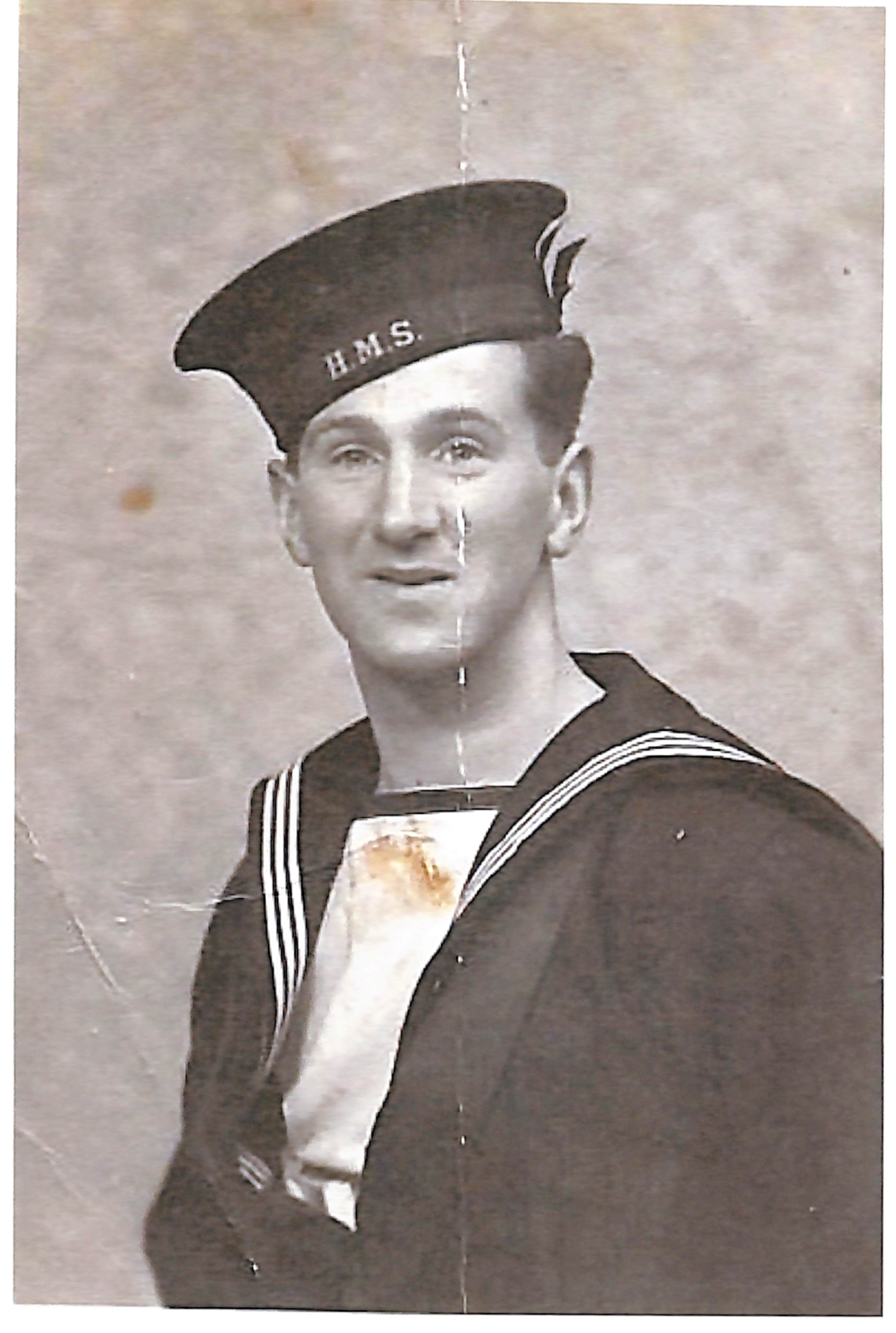
Charles Ideson was baptised on 10th March 1912 at Bolton Abbey, five miles east of Skipton. His parents, John Thomas Ideson and Lillian (nee Pletts) lived at High Gramsworth, Barden and their families came from the moorland farming hamlets nearby. Charles had an older brother (Rennie), two older sisters (Phyllis and Mary) and two younger brothers (Tom and Dennis).
His great-grandfather, Nathan Ideson, and grandfather, Charles Ideson were both farmers- in 1861 Nathan farmed 40 acres in Howgill. His father, John Thomas Ideson (1886-1918) was a forester in 1911, but served as a Private in the Royal Northumberland Fusiliers during WW1, and died (aged 32) on 28th July 1918, possibly as a PoW as he is buried in Cologne. Lillian was widowed with six children aged from two to ten.
By 1939, only Charles was living with his mother, now on Main St, Skipton, working in the leather trade as a ‘combing leather worker, finisher and dresser’. His three brothers worked as a pigman (Rennie), heavy estate worker (Tom) and Dennis (now married) was a roadstone quarryman.
Aged 29, Charles joined up on 16th June 1941, under the National Service (Armed Forces) Act 1939, with the service number, PJX 278154.
After onshore training near Ipswich (HMS Ganges, Shotley) and Portsmouth (Victory I), he joined HMS Trinidad in Devonport, Plymouth on 1st Oct 1941 under Captain LS Saunders, as an Ordinary Seaman. After trials off Plymouth, HMS Trinidad sailed to Greenock 26th October and on to Scapa Flow on 6th November where they took part in exercises until 7th Jan 1942.
On 8th January 1942 they left Iceland as escort for PQ8, arriving in Archangel on 18th Jan. One merchant vessel was damaged and one escort sunk (there were just 2 survivors). Six days later, on 24th March they left Murmansk escorting QP6. HMS Trinidad arrived back in Scapa Flow on 30th January 1942.
HMS Trinidad spent February 1942 patrolling the area between Iceland and the Faroes, and on 7th March left Scapa Flow to refuel ships escorting PQ12 (which departed Reykjavik on 1st March and arrived in Murmansk on 12th March), returning to Scapa Flow on 11th March. From 12-14th March 1942 HMS Trinidad was back on patrol between Iceland and the Faroes.
On 20th March, PQ13 left Reykjavik for Murmansk, and HMS Trinidad was on escort duties from 23rd March. After a 2-day gale, and subsequent round up of scattered ships, enemy aircraft and destroyers arrived 28th March. HMS Trinidad was narrowly missed by three bombs from an aircraft which dived out of a cloud. During the afternoon, HMS Trinidad was persistently dived bombed by Ju-88’s but she sustained only some minor damage from near misses. At 4am on 29th, HMS Trinidad opened fire on a U-boat (U-378) which dived to safety. Later on 29th HMS Trinidad fired on 3 German destroyers, but was hit with one of its own torpedoes, which had misfired due to ice. 32 men were killed, including 17 of the 21 sailors in the Transmitting Station, who drowned in oil. Survivors included Lieutenant Commander Williams as well as composer, George Lloyd, a Royal Marines bandsman who had earlier written the ship’s official march. This was performed at the Last Night of the Proms on 7 September 2013, in the presence of the last surviving crewman from HMS Trinidad. Trinidad was able to limp on and arrived in the Kola Inlet on 30th March. 5 ships on the convoy were sunk.
From 3rd April-2nd May HMS Trinidad was docked in Murmansk for repairs. During this time, on 16th April 1942, Charles was promoted from Ordinary Seaman to Able Seaman.
On 13th May, she departed Murmansk, but only slowly due to the temporary repairs, and escorted by two ships which were also damaged. She carried many survivors of HMS Edinburgh (sunk while escorting QP11 on 2nd May). The following day, 14th May, HMS Trinidad was attacked by German aircraft, firing both bombs and torpedoes. A full and graphic account of the attack can be read at https://www.world-war.co.uk/trinidad_loss.php. Eventually, three bombs hit near the previously damaged hull, blowing off the temporarily welded plates and drowning everyone in the area and the fourth bomb hit near the bridge, causing a serious fire. 63 men were lost, including twenty survivors from HMS Edinburgh. Early in the morning of 15th May, the fire was out of control and a decision was made to abandon ship. Charles Ideson was one of the last men off . As the ship increased its list to starboard… several men were acting as anchor men by attaching themselves to the higher guardrail. From each of these, a dozen or more men hung… Commander George Collet was directing each man in turn to let go and slide down to the lower rail, before climbing Somali’s side. Able Seamen Charles Ideson and Jim Harper were among the last to make this difficult and awkward climb… as Ideson’s and Harper’s feet touched the deck, they turned to help those following.
HMS Trinidad was scuttled at 01.20 on 15th May 1942. HMS Somali, presumably with Charles Ideson on board, arrived on the Clyde on 19th May.
Charles seems to have spent the next 21 months at onshore bases, and on 26th March 1944, now trained as a radar operator, he joined his second ship, the brand new HMS Myngs.
By August, HMS Myngs was off Scapa Flow on exercise and as escort for minelaying in Norwegian fjords. On 18th Aug HMS Myngs left Scapa Flow as part of Operation Goodwood- to inflict sufficient damage on the German battleship Tirpitz to put her out of action for the remainder of the war and to provide cover for the passage of convoys JW 59 and RA 59A. This was unsuccessful and by 26th August, HMS Myngs had arrived in the Faroe Islands to fuel. They were back on operations the following day. On 29th Aug there was another air attack on Tirpitz and this was also the day Charles received a certificate for crossing the Arctic Circle.). On 3rd Sept HMS Myngs arrived in Scapa Flow and between 11th -13th Sept the ship took part in Operation Begonia- minelaying in the Norwegian fjords.
On 16th Sept HMS Myngs left Scapa Flow to escort Convoy JW60 ,which arrived in the Kola Inlet on 23rd Sept without loss. By 28th September they were back on minelaying duties until the end of October. Between 11th and 29th Nov, HMS Myngs took part in Operations Counterblast and Provident, which involved attacking enemy shipping.
Charles Ideson seems to have left HMS Myngs on 11th December 1944 and spent the rest of the war at HMS Collingwood, an onshore base in Hampshire.
He was demobbed from HMS Victory, Portsmouth on 6th January 1946
After the war, Charles returned to Skipton and married Violet Alderley in the summer of 1952 (aged 40). He died on 3rd Sept 2003, aged 91.