
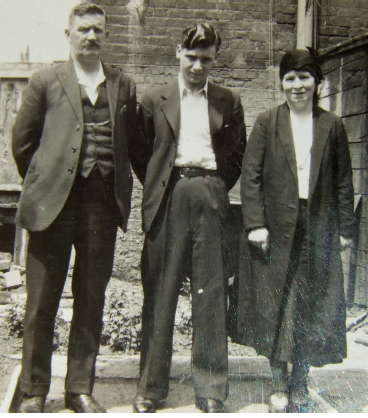
Douglas Liddell served aboard SS Induna in convoy PQ13. The second youngest in his family, he served in the Merchant Navy, opting for duty in the engine room – just like his father, Alex, had done. His three brothers, William, Alexander and Donald also joined the Merchant Navy.
Born on December 25, 1915, Douglas stood 5’4 with green eyes and brown hair. After finishing school, he started work with Cunard Line in March 1936. His first job, was on SS Ausonia, working as a trimmer – someone who delivered coal to the ‘fireman’ who then shovelled it into the boilers. He was 21.
It was hard work, but he was grateful for the dry roof over his head, the plentiful food and getting to see the world when the ship docked. World War II broke out while Douglas was still working on the SS Ausonia. Suddenly, going to sea in the Merchant Navy became a dangerous occupation. He would make ten short voyages on smaller ships up to April 1941, before transferring to SS Lulworth Hill.
Douglas transferred to the SS Induna on October 4, 1941. This transfer came with a promotion to the role of ‘greaser’ – a job with great responsibility that involved keeping up oil levels on various sumps, generators and steering gear.
Six months later, SS Induna joined the Arctic Convoy, PQ13. There were 19 merchant ships in PQ13, along with their Royal Navy escorts. They left Loch Ewe in Scotland on March 10, bound for Murmansk in the Soviet Union. The SS Induna was loaded with 2700 tons of mixed war material and aviation spirit – essential supplies for the Soviet war effort against Germany.
The convoy soon encountered heavy weather. Snow squalls were recorded on March 25 and 26, causing the Induna to become separated from the main convoy. Shortly after, they spotted the British steamship Empire Starlight and the Panamanian, SS Ballot, along with small escort vessel, HMS Silja – they quickly joined up with them.
A German reconnaissance plane soon found them, dropping a green flare nearby. Gunners aboard Induna immediately opened fire, hitting the aircraft 200 yards away on the starboard engine, causing a bright orange flash and thick black smoke. The aircraft then disappeared into the snow squalls. Despite this, the German plane was still able to transmit the sighting to Gruppe Nord who then sent a wolfpack, consisting of four U-boats to investigate.
The weather somewhat cleared on March 28 – but this proved bad news for Douglas and his fellow crew members aboard the Induna. The small convoy, now consisting of six ships with escort, found themselves under attack by the Luftwaffe, getting dive-bombed by Ju88s. Two stragglers, SS Raceland and SS Empire Ranger were sunk during the encounter. More ships were damaged or abandoned later that day following an attack by a Messerschmitt 110.
It was then agreed that a more northerly route should be taken by those remaining – but around midnight, they encountered thick pack ice. At 4.00am HMS Silja requested Induna to give her a tow as they were short on fuel, but both ships then got stuck in ice. It took them hours to break free.
Meanwhile, the U-boat wolfpack was closing in. During the evening on March 29, the tow line from Induna to Silja parted and both ships disappeared from each other in the continuing snowstorms. Despite blowing whistles and using fog horns, the Induna gave up around 4.00am on March 30 and decided to go it alone for Murmansk.
An hour later, the SS Induna was spotted north-east of the Kola Inlet by U-209. It was 5.52am. The U-boat then alerted the others and fired two torpedoes – both missing the ship. While U-209 repositioned itself for another attack, U-376 fired a torpedo at 7.20am – it hit the Induna on the starboard side, where the aviation spirit was held.
A huge explosion erupted. Flames shot 100 feet into the sky. Anyone in the vicinity was killed immediately. The explosion threw up barbed wire onto the deck, which had been stowed in the hold. More drums of aviation spirit quickly ignited.
Port and starboard lifeboats were launched, while the Second Mate destroyed the confidential papers. Several men had no shoes, and their feet were ripped to shreds on the wire as they ran towards lifeboats. Others had to run through the fire which caught their clothes and hair alight. When the lifeboats were 200 metres away from the cripped ship, the U-boat surfaced. It fired another torpedo, striking the starboard side once more, which caused another explosion, sending flying debris close to the lifeboats.
U-376 would later disappear with its entire crew on April 13, 1943, in the Bay of Biscay.
The SS Induna sank within ten minutes, disappearing beneath the waves around 8.00am. The Master and several crew members perished with it.
Second Officer Evan Rowlands managed to get into the starboard lifeboat and took charge of the 31 crew members. It was cramped, freezing, and the men had limited experience with handling a boat in the frigid ocean. He ordered them to start rowing, while he set the mast and sail.
The lifeboat was stocked with basic supplies – but the water was frozen solid. Someone had also managed to smuggle whisky aboard. During the first night, some men drank a significant amount of it – the majority of those then died in their sleep. Their fellow crew members gently placed their bodies over the side. It’s believed that Douglas was one of those who perished this way. His official death record states he died of exposure on March 30.
The remaining men had to contend with the leaking lifeboat, while getting battered by rough seas crashing over them. Everyone suffered frostbite on their hands and feet – the latter constantly in water. They rowed in shifts to keep warm – but their hands were so numb they could barely hold the oars.
41 survivors abandoned the SS Induna on that fateful day in March 1942. The lifeboats were eventually picked up by a Russian minesweeper on April 2. Only 30 men were still alive – two of those would later die in hospital at Murmansk. Many of the survivors lost limbs.
The skill and leadership of Second Officer Evan Rowlands undoubtedly saved lives and he was awarded the MBE. Able Seaman Walter Pike was commended for his gallant service in trying to stop the lifeboat from leaking – he lost both feet in the ordeal.
The Liddell family received a telegram notifying them of Douglas’ death. It was later followed by the arrival of a small cardboard box that contained his medals and condolence slip. Douglas was awarded the 1939-45 Star, The Atlantic Star, War Medal and later, the Arctic Star. His name is engraved on Panel 58 of the Merchant Navy Memorial at Tower Hill, London.
[submitted by Simon Muggleton, edited by Rowan MacDonald]