
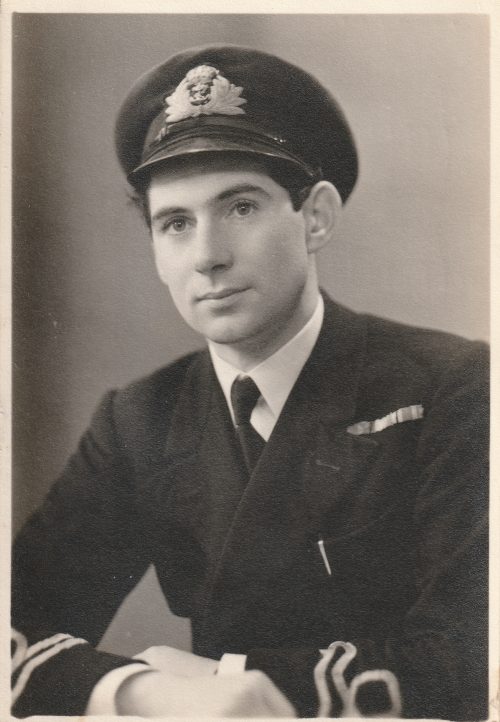
Edward Sullivan
(29 April 1921 – 8 November 2011)
Edward (Eddie) Sullivan served in the Royal Navy Volunteer Reserve during the Second World War and was a C.W. (Commission and Warrant) candidate on the tribal class destroyer HMS Somali.
He was on board during several Russian convoys and the convoy to Malta in August 1942.
On 20 September 1942, during the return convoy from Russia QP14, HMS Somali was torpedoed by U-boat U-703. Eddie was one of those who volunteered to remain on board after Somali was torpedoed as she was taken under tow by her sister ship HMS Ashanti, with the hope of reaching Iceland. After 4 days being towed and with Iceland in reach, a severe storm broke out on the night of 24 September. The Somali was broken in two and Eddie was one of the fortunate few who was rescued from the icy arctic waters.
In later life, he wrote a letter to Lord Lewin of Greenwich, detailing his experience when HMS Somali sunk. (A copy of the letter can be found in the Imperial War Museum collection.)
“My Mess on the ship was level with the main deck and I was resting there when I was woken by a great cracking sound. It was of course the ship breaking up. I dashed up to the focsle (port side) and stationed myself by the guard rails. I watched the after portion of the ship disappear into the sea and I was still clinging to the guard rails when the bridge went under.
I was very fortunate because a Carley float, which had jammed near the ready-use shells broke loose and I practically fell into it as I let go to enter the water. I was able to hang on to the ropes along the side of the Float and others soon joined me there.
I think it was Lord Middleton which then came up to us, but the rise and fall of the sea was such that those on the side of the Float nearest to the ship were pushed under and disappeared. We were then abandoned because of the risk to those left and we drifted away.
A searchlight, or maybe it was a large signal lamp, then located us and the next I knew was seeing the side of a ship, which turned out to be the [HMS] Eskimo. By this time, I had lost the use of my right arm and my legs, but as we rose on the crest of a wave, I managed to take my weight on the side of the Float and take a few loose turns round my arm on a heaving line dropped from the side of Eskimo. As I went down with the trough the line tightened round my left wrist and I was able to hold on just long enough to be hauled aboard. I remember trying to get a hold of the heaving line with my teeth because it was slipping from my grasp. Once on board I was wrapped in blankets and put in a bed – it was either in the Sick Bay or the Captain’s cabin. Some cuts on my feet were treated (I had been in my bare feet throughout) and I was transferred to a Mess. A P.O. (Petty Officer) called Morris had been alongside me on the Float but I didn’t see him again.
In due course I was able to send a telegram to my parents from the Depot ship and eventually we boarded a train for Portsmouth. I remember being given food by ladies at Perth, where the train stopped briefly. After arrival at Portsmouth, I was kitted out at the Barracks and then had to travel up through England again to get to Ireland on leave.
I had passed my Selection Board and later went to Lancing College and King Alfred, Brighton (leaving as a Sub. Lt. R.N.V.R.)
About that time, I went to see the mother of another C.W. candidate from the Somali called Pitt-Pitts, who unfortunately did not survive. She was heart-broken, poor woman, and kept saying what a strong swimmer her son had been. I hardly knew what to say.
I have since discovered that Somali was torpedoed by the Submarine U703, commanded by a Kapitanleutnant Heinz Bielefeld, and that a schnorkel submarine U1222, on patrol from Kiel and commanded by a Kapitanleutnant Heinz Bielefeld, was sunk by a Sunderland from 201 Squadron (Flt. Lt. L.B.F. Walters D.F.C.) on patrol west of La Rochelle. There were no survivors. So, that’s the way it goes.”
[contributed by Sarah Smart, granddaughter of Edward Sulllivan]