
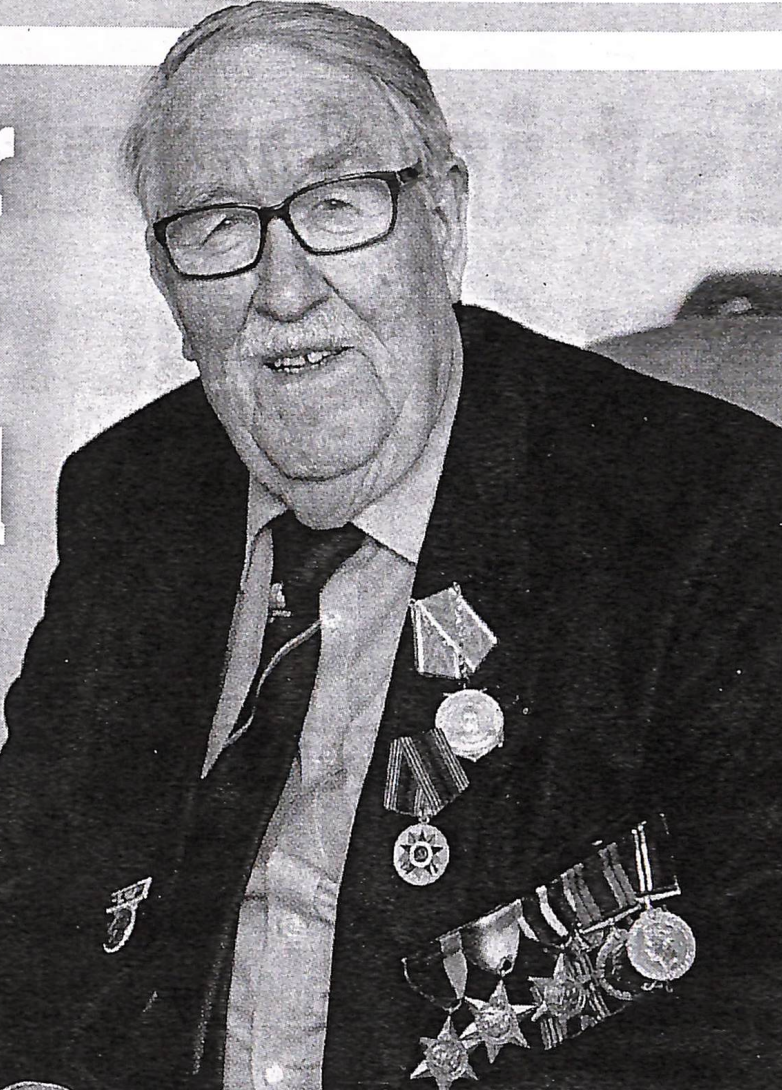
[by volunteer Dave Cole]
Geoffrey Shelton was born in Staines in 1926 and joined the Royal Navy in 1943. After serving at various training bases, he joined the recently-completed escort carrier, HMS Vindex, on which he served until April 1945. Whilst on Vindex, Geoff participated in eight Arctic convoys, serving as a masthead lookout and Oerlikon gunner. Vindex carried twelve Swordfish and eight Sea Hurricanes and was involved in the sinking of 5 U-boats. After Vindex, Geoff served on the destroyer HMS Mauritius and the light cruiser HMS Croziers. Geoff left the navy in 1948 and spent the rest of his working life in the insurance industry.
Geoff became very active in the Russian Convoy Club and participated in many visits to Russia. He made close friendships with several Russian Embassy personnel and on one of his visits to Russia, even managed to bypass the bodyguards and speak to Vladimir Putin. Through his activities, Geoff developed a love for Russia and its people.
In 2013 Geoff published a book, “Masthead Lookout” (Austin Macauley, 2013), describing his experiences in the Royal Navy. It gives a very personal account of shipboard life escorting the convoys, describing the hardships but also the great comradeship. Here are some of his descriptions of living conditions:
“Washing and cleanliness ceased to be of prime importance . . . . you felt dirty and unclean, and knew you were dirty and unclean”
“. . . . the mess deck, while it was better than the mast, was not welcoming, there being no heat, and water sloshing back and forth all night long. You could only remove your sea boots once you were in your hammock and then you tied them to the clews so they would be ready to put on in the morning.”
“As you pulled up your one and only blanket, you looked up at the icicles hanging from the deck head and snapped them off in case they dripped over you.”
“We were tired and exhausted but we didn’t sleep . . . . the time was spent in trying to rub life back into your frozen limbs.”
“It was close to forty below zero as we stood our watch . . . . we were shaking from the wicked penetrating cold. Our clothes were still wet from our previous watch as there was no way of drying below decks”
“We cleaned the ice off our binoculars . . . . when we came to remove them we found them welded to our eyelashes with ice.”
In an article written celebrating the 70th anniversary of VE Day, Geoff speaks of the fears they all had and the sorrow of losing comrades.
“When we were young . . . . we could shrug off the sub-zero temperatures and the sleepless nights. We tolerated the storms and violent seas, we accepted the low pay and the freezing mess decks. We learned to live with fear and to control that inner feeling that screamed for you to be somewhere else. Death was never far away, but we all believed that it would be someone else but never us. But when it came to pass that we lost a shipmate, we all accepted it with a quiet acquiescence, a sorrowful resignation to something we couldn’t change. If he had gone overboard we would say a silent prayer, if he hadn’t then we would have sewn him up in his hammock and with a prayerful service offer his body to the deep. For twenty-four hours the mess deck would be quiet . . . . There was sadness but there were no tears. 70 years later . . . . I find I grieve for my shipmates now more than I ever did . . . . and in my private moments I weep for them.”