
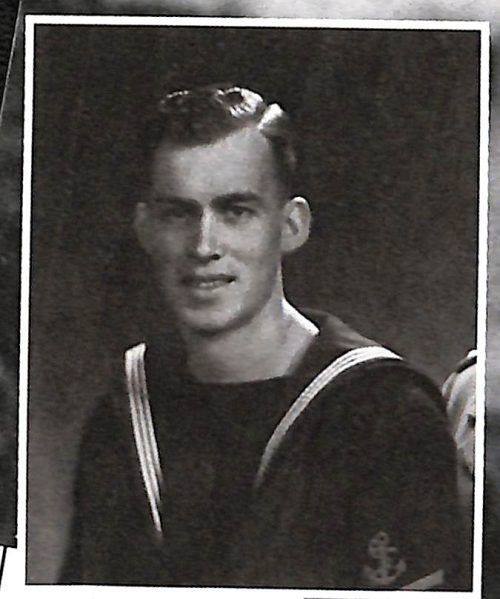
Bert Wade was born in July 1921 on Canvey Island, Essex. A Royal Navy Leading Signalman, he served on more than forty ships during World War II – entire books could easily be written about Bert’s remarkable war service! Among those forty ships was the SS Empire Byron, which was sunk with the loss of six crew members following the scattering of Convoy PQ17. Bert was one of sixty-two survivors who spent six days in a lifeboat in the Barents Sea, then a further two months recovering from frostbite in the USSR before returning to the UK. This is his story.
Bert left school in 1935 at the age of fourteen. He enjoyed being a Scout on Canvey Island and working alongside his parents in their fruit and vegetable nursey. He started work as a ‘telephone boy’ in October of that year at the gasworks in Southend-on-Sea, Essex – this required him to travel by bus and train to and from work each day.
It was 1939 when Bert was at Scouts and shown a request for volunteers with signal experience. He applied and three weeks later was undergoing medicals and enrolled in the Royal Navy where he attended HMS Arthur (Skegness). He passed the signalman’s exam in 1940 and was drafted to HMS Eagle, Naval Control Liverpool – home to Convoy Control for the North Atlantic. Bert then found himself on Vice Admiral Dawson’s staff on a convoy bound for Canada.
His first experience on the convoys was an eye-opening one, as he watched the Admiral control over sixty merchantmen and escorts. He didn’t speak about his war experiences until many years later in 1976.
PQ17 marked the start of a period that Bert would later describe as “a very traumatic period in convoys for me.” It was June 1942 when he arrived in Reykjavik, Iceland and was transferred to the Empire Byron, bound for Arkhangelsk. The ship was carrying ammunition, planes, tanks and lorries for Russia – approximately £200m worth of war materiel.
It wasn’t long after leaving Iceland that they noticed a German plane tracking their every move. It was July 4th, around 2.00am, when the tracking plane was suddenly replaced by over one hundred bombers and torpedo aircraft that unleashed hell upon them.
“Gunfire from escorts, bullets from other ships, bombs from dive bombers went on all day and many ships were hit including a Russian tanker astern of us that burst into flames. A lot of damage was caused to our superstructure due to the crossfire being so low…”
The First Officer aboard Empire Byron appeared to “go a little off his mental balance whilst counting attacking aircraft” but thankfully, with assistance from crew, was able to recover. Two British submarines astern of them dived to escape the incessant attacks.
“I remember watching a German dive bomber being shot down and belly-flopping on the water in front of us – another seaplane landed on the water by it and rescued the pilot as if it were an exercise. He was given a big cheer by the ships in the vicinity.”
A US escort ship ahead of Empire Byron was particularly lucky when a dive bomber dropped its load immediately alongside them, causing the ship to signal: “that’s no way to celebrate Independence Day!” before turning 180 degrees at full speed to chase through the convoy, firing as they went.
“At one point, I took over the Bridge Port machine gun and fire at Stukas attacking the Commodore ship…”
By evening, the attack had somewhat died down, but rumours were starting to circulate regarding the presence of feared German battleship, Tirpitz. It was difficult for those involved to know what was really happening. At 8.20pm on July 4th, the signal was given to scatter the convoy. By midnight, Bert and those aboard Empire Byron were on their own and steaming full speed.
“This was very eerie in the sunlight on the flat calm icy sea.”
Around 6.15am, a tremendous explosion shook the ship, and it was immediately clear the ship was sinking. Bert was positioned with one of his mates on the upper deck but knew one of his friends, Stan, was still below.
“We were told that personnel below decks were all killed but due to our astonishment, Stan appeared at the hatch cover, blackened face and very shocked.”
Bert was somehow managed to scramble into a lifeboat amidst the chaos. A U-boat was still circling the area and filming the unfolding situation. Bert and others bailed water out while rowing over to the other boats to which they transferred across. Sea burials were later held for those on board who had died from the freezing conditions and injuries.
“It appeared that 17 could not be accounted for and 4 had died in the boats. The hymn, ‘Abide with Me’ was sung in the boats whilst the burials took place – the singing seemed to echo across the icy water, and it was a relief to get down to rowing to warm up.”
Bert and those terrified souls in the boats had limited supplies and had to contend with the lifeboats having suffered damage during the air attacks. As the days passed, it was difficult to know what date or time it was, due to the continual sunlight and no sunset.
“The days went by with an eerie feeling in the flat calm, with the occasional rumble of icebergs breaking up and ice cracking. It was possible to ‘feel’ the bergs coming by the cool draught ahead of them.”
Bert would receive a welcome gift on the morning of his 21st birthday, as a ship had been reported approaching from further ahead. They had rowed approximately 700 miles. It was a corvette that was out looking for survivors.
“It was a pantomime getting up the scramble nets of the corvette and being carried below where hot coffee and bread was provided. Not many men could stand and passed out very quickly. I burnt the whole of my mouth on the hot coffee, but the bread was good.”
Bert’s feet were unable to bear any weight due to their poor frostbitten condition. The corvette continued searching for two days but didn’t find any other survivors, so returned to Arkhangelsk. Upon arrival, survivors were transferred to an empty large school as the local hospital was full of casualties from Stalingrad. There were approximately 750 survivors, so facilities were stretched beyond their limits.
“We were issued with tickets for everything – especially meals, that consisted mainly of grass soup, raw salmon and rice. The only plentiful item was the issue of vodka with every meal.”
Bert didn’t feel welcomed by the Russians and was not given medical attention. They were eventually transferred to a small base for routine work, but were not permitted to travel anywhere, and were continuously challenged by the armed Russian soldiers.
“Arrangements were made for a telegram to be sent from all survivors to their next of kin and a British plane on the way home took one-page letters. Trying to explain Canvey Island to the Russian Post Office was nearly impossible.”
On September 1st, Bert sat down to write a letter back home. A shortened extract follows:
Dear Mother, Dad and Len,
I expect you have been wondering what has become of me during the past months – I am well now and looking forward to coming back. I cannot explain much as you will understand. I trust and hope you are all very well and happy.
I have constantly thought of you all and am longing to be with you again.
I have experienced some very cold weather and am now in Arkhangelsk, North Russia.
Kind regards to all friends. Lots of love – keep smiling!
Yours always,
‘Big’ Bert xxxxxx
Bert’s time in Arkhangelsk came to a sudden end at 3.00am on September 12th. Ferries were used under armed guard to put survivors on ships and Bert found himself alongside two of his good mates, Stan and Taffy, on HMS Pozarica, an anti-aircraft ship. Commodore Dowding was requesting a Leading Signalman to accompany him on the new Commodore ship for QP18.
“We had to toss up – loser to go with the Commodore on the Merchant ship. I won and was put back in the Sick Bay which I discovered was very much below the water line! All hope faded, especially when all watertight doors closed at ‘Action Stations’ it felt terrible.”
Bert later described the convoy home as a “very lively affair” – and it certainly was. Six ships were sunk, including the Commodore’s which his mate, Taffy, had joined – thankfully, he would survive, again, and the two would reunite in Glasgow on the way home.
The men eventually landed in Belfast. They had not been ashore long when they were arrested by Naval Patrol for being incorrectly dressed! They explained their situation in detail and were placed on a ferry for Liverpool, only to find their arrival there just as disheartening with heavy rain and nobody to meet them.
“I went on a ‘month’s survivors leave’ to Canvey Island. My legs and feet gradually improved and after our return to Liverpool, about six of us were put on special heat treatment at a local hospital. This did not last very long because a very ‘snotty’ Commander arrived one day and enquired what all these layabouts were doing! We were all ordered back to base for sea duty.”
Bert would then join HMS Durban Castle and head out on another convoy – this time to Algiers, where he was pleased to feel the warmth of the Mediterranean sun for a short period, despite a brush with an Italian liner and German tanker!
His time as Leading Signalman would incredibly go onto consist almost entirely of convoys around the world, until his discharge from the Royal Navy on 19th January, 1946.
Thank you for your remarkable service, Bert.
[contributed by volunteer Rowan MacDonald]