
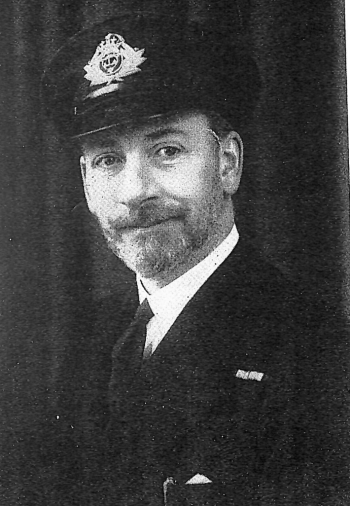
Horace Bell was Chief Radio Officer on the SS Copeland during its mission from Scotland to Arkangel, as part of Arctic Convoy PQ18 in September 1942. PQ18 was the largest convoy to have been assembled at that time.
As a result of lessons learnt from Convoy PQ17, which had suffered terrible losses with many ships sunk by enemy attacks, PQ18 was given a stronger Allied escort. Reports made public after the war indicated 75 Allied warships, including an aircraft carrier, had been assigned to PQ18 as a protective shield.
The SS Copeland was assigned to the convoy as a Rescue Ship. The principal task of a Rescue Ship was to save the lives of Seamen whose ships were sunk by enemy action. The Admiralty looked for vessels that were small and easily manoeuvrable with good speed. They sailed at the rear of a convoy to pick up survivors. The ships were crewed by Merchant Navy Masters, Officers and Seamen. This was important because the Rescue Ship could work independently during an attack and move immediately to rescue the ship-wrecked without awaiting orders.
Convoy PQ18 was first sighted by German spotter aircraft on 9th September. From then on German aircraft shadowed the convoy’s movements almost continuously. Horace expected the attacks to start at any moment, but for the next couple of days it remained quiet. It hardly seemed possible they might get through scot-free – they didn’t.
The first attacks started on 13th September. U-Boats penetrated the escort screen and two merchant ships were torpedoed. The first sunk in 13 minutes. A total of 10 ships were lost that day.
Over the next five consecutive days the convoy came under sustained torpedo attacks from U-Boat submarines, and German bombers operating from bases in Norway. Copeland itself came under direct attack, surviving several close-shaves, including a torpedo passing directly under the ship.
Despite the fierce defence put up by the Allied warships and aircraft operating from the carrier PQ18 lost a good number of ships, but the majority did make it safety to Arkangel. Copeland was busy rescuing survivors throughout the voyage and saw them safely ashore.
Horace wrote a detailed account of the mission, based around his own experiences and the ship’s radio transcripts which it was his duty to record. He dedicated the account to his son Dugal. There were later official Admiralty accounts of PQ18, but Horace’s account also became widely acknowledged and respected. During the 1960s he was contacted by Vice Admiral B.B. Schofield who was conducting research for a book he was writing about Rescue Ships during WW2. A copy of Horace’s account of PQ18 is held in the ACM archives.
(Footnote: Horace Bell also served on the SS Zamalek, which was also a Rescue ship accompanying arctic convoys to Russia. Sadly Horace’s notes do not include any details of his time on the Zamalek).