
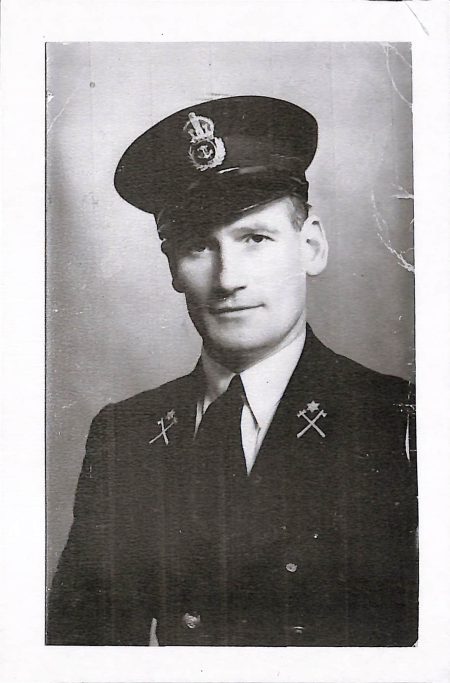
A Naval Life Shaped by Skill, Service, and Survival
John McNee was born in Birkenhead, Cheshire, on 20 June 1910. He left school at the age of 14 and was apprenticed to a local shipbuilder as a shipwright. During those formative years, he also joined the Royal Naval Reserve, learning the discipline and traditions of the Senior Service. By 1931 he had completed his apprenticeship and qualified as a shipwright. However, “the slump” (the Great Depression — hugely impacting across the world at that time) left work scarce, and John, like many men of his generation, looked to the Navy for a secure career.
In October 1931 he joined the Royal Navy, entering Devonport as a Stoker 2nd Class. It was a somewhat humble start for a trained shipwright, but such was the rigidity of naval structures at the time. His first postings were to HMS Vivid and then to the destroyer HMS Westcott. By 1932 he had advanced to Stoker 1st Class, gaining his first experience at sea in the cramped heat of the engine rooms.
John’s abilities as a shipwright, however, were soon to be recognised, and his career began to follow a different path. In June 1935 he joined the aircraft carrier HMS Glorious. There he was “made up” to Shipwright 4th Class, working with the other shipwrights aboard to improve the landing gear for aircraft operating from the carrier. These were the pioneering years of carrier aviation, and his role was to help adapt a great battle cruiser-turned-carrier to the rapidly evolving demands of naval aircraft. It was skilled, technical work, and recognition of his abilities saw him promoted steadily.
Through the later 1930s John served aboard the battleships HMS Resolution and HMS Ramillies, before joining HMS Royal Oak in January 1939. He remained with her until June of that year — just four months before she was famously torpedoed and sunk at anchor in Scapa Flow with the loss of 833 lives. It was a narrow escape, and one of several occasions when fate seemed to intervene in his career.
By the outbreak of the Second World War, John had joined HMS Norfolk, a County-class heavy cruiser. His timing meant that he found himself in the thick of some of the war’s most dramatic naval operations. In May 1941 HMS Norfolk was part of the group of cruisers shadowing the German battleship Bismarck. From her deck, John watched the terrible destruction of HMS Hood, blown apart in moments after a shell struck her magazines. HMS Norfolk continued the pursuit, one of the ships that helped guide the Home Fleet to its decisive engagement that saw Bismarck sunk.
Later, aboard HMS Norfolk, John endured the heavy duty of escorting Arctic convoys to Murmansk and Archangel. These voyages through ice, storms, and U-boat waters tested every man to the limit. He told of snow and blizzards, of ships sheathed in ice, and of the haunting sight of their own sailors left in the water after a torpedoing, passed by because the convoy could not risk stopping. Yet there were moments of humanity too — each mess baking extra bread as the ships neared Murmansk, so they could help feed the starving Russian population. By April 1943 John had risen to Chief Shipwright (Temporary), his skills and reliability recognised at the highest level.
After nearly four years aboard HMS Norfolk, he transferred to HMS Eland, a repair and depot ship based on the West African coast, and later to HMS Philoctetes, where he became Permanent Chief Shipwright. His wartime service took him from the freezing Arctic to the heat of Africa, working to keep ships battle-ready in every climate.
When peace came, John continued in the Navy. In 1949 he was posted to HMS Tamar, the Royal Navy’s shore base in Hong Kong. His wife and three daughters joined him there, experiencing life in the Far East at the very beginning of the Cold War. Returning to Britain in 1952, he achieved one of the proudest milestones of his career: promotion to Commissioned Shipwright Officer aboard HMS Orion. Very few men from his branch reached commissioned rank, and for John it was recognition of decades of service, skill, and perseverance.
John remained in the Royal Navy until 1963, retiring as one of its few commissioned shipwrights. His medal entitlement reflected both his long service and his presence in some of the hardest-fought theatres of the war: the 1939–1945 Star, Atlantic Star, Defence Medal, War Medal 1939–1945, Long Service and Good Conduct Medal, and, awarded later, the Arctic Star in recognition of those freezing convoys to Murmansk and Archangel.
John married in June 1935 at St Thomas’s Church, Keyham, Devonport. He and his wife had three daughters, and the family remained close through his many postings around the world. After his wife’s death in 1973, John followed her three years later in February 1976.
A quietly intelligent and unassuming man, remembered by his family with great affection, John McNee’s naval career spanned more than three decades. From a boy shipwright in Birkenhead to Commissioned Officer of the Royal Navy, he witnessed some of its most famous battles, survived the loss of comrades and ships, and served across the globe. His story is one of dedication, skill, and quiet endurance.