
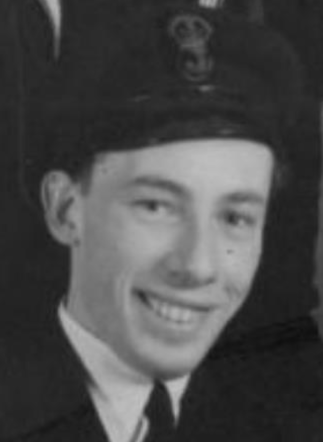
Like most my dad did not talk much about the war but was still haunted by monthly nightmares twenty-five years later when I was a boy. His mother had kept a wartime scrap book with photos of earlier voyages involving his father (a career Navy man who was at Jutland in WW1) and a few newspaper cuttings and photos about dad. Sadly, when dad transferred this material to a new book before his passing in 1996, some of the original photographs were lost.
On different occasions dad mentioned the following memories of the Arctic Convoys:
Soon after joining the Royal Navy Fleet Air Arm, he took part as an extra in the filming of the propaganda recruitment film” The Volunteer” which was released in January 1944. Even though he had a reserved occupation dad volunteered shortly after completing his five-year apprenticeship in April 1943. He cycled day and night with two companions from near Great Yarmouth to Oxford on a three speed Stanley Archer bicycle (with only one working gear) to get back for Christmas one year. Getting transport for the return journey back to base was apparently much easier.
He served on two different escort carriers HMS Vindex and HMS Campania and took part in two artic convoys. He recalled U-boats, Junkers Ju 88s, hedgehogs and pom poms, clearing the decks of ice, 50ft waves, regular crash landings, daily tots of rum, men in the water, along with smoking a lot of cigarettes. His battle station was in the hangar, next to fuel-laden aircraft, armed with only a handheld fire extinguisher. The worst job was submarine watch on the exposed lookout platforms at the top of the island superstructure above the bridge; wet clothing made hypothermia a constant threat.
Hammocks and cold-weather gear were shared with two others on an eight-hour rotation. One terrified sailor even slept on the doorstep of a watertight door, afraid of being trapped below if the ship was hit. On one occasion, to get the best hammock, dad joined the ship three days early. This involved flying out from near Campbeltown (HMS Landrail / RNAS Machrihanish) in the back of a returning Swordfish. When the pilot got to the carrier he started slowly climbing in a wide spiral to several thousand feet before rolling into an unannounced suicide dive landing – an experience dad never forgot. It was often said that in bad weather the carrier had to slow down so that the Swordfish could catch up.
Dad was responsible for maintaining the carrier’s aircraft: initially Sea Hurricanes and Swordfish before the Hurricanes were replaced with Wildcats. He therefore must have served with 825 Naval Air Squadron on HMS Vindex during convoy JW59/RA59A in August 1944. 825 squadron left HMS Vindex after this convoy and became land based for a couple of months with Coastal Command. Newly formed 811 Royal Navy Squadron replaced them on HMS Vindex. This was reversed after one convoy and 825 Squadron unexpectedly returned but this time with Swordfish and Wildcats. Records and recollections suggest dad must have been reassigned at this time to 813 Royal Navy Squadron who were deployed on HMS Campania. Dad recalled standing behind the newspaper reporter when the widely published photograph was taken of the carrier HMS Nairana at an almost unbelievable angle in the worst storm of the war. This means he must have served on JW64/RA64 in February 1945.
Dad features in a group photograph taken at HMS Landrail in April 1945 of 813 Squadron which is published on page 10 of the article “813 Squadron Aboard Campania” available on the museum website — he is the figure seated farthest to the right on the aircraft’s wing. He also kept a series of other photos taken that day, all showing the same Swordfish aircraft with different crew members in front including the one featuring the RATOG rocket (dad is bottom right). These have helped us to identify some of his wartime comrades, as preserved in the “Convoys Remembered” section of the museum website.
With the war in Europe over, Dad retrained as a beach commando and was on route to the Pacific theatre on VJ Day. He then spent nearly two years in Cape Town tasked with the job of pushing surplus military aircraft off ships into the ocean. Eventually, he returned home by a multi-day train journey to Mombasa in Kenya and then a ship via the Suez Canal. There are photographs of the train station sign at Kimberly in South Africa, the Holy Ghost Cathedral and Fort Jesus in Mombasa, along with the Ferdinand de Lesseps monument at the northern entrance to the Suez Canal.
Whilst dad refused to collect his wartime medals the family has recently received dad’s Artic Star.
[written by son James Baker]