
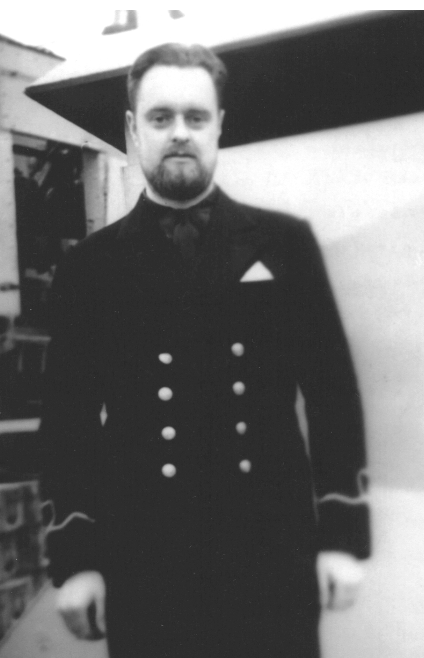
My name is Lynne Stewart (Stopani). I am the daughter of an Arctic Convoy veteran, Thomas J. Stewart, born in Tottington, near Bury, Lancashire on 15th May 1914.
He attended school in Bury, leaving to study engineering at a Technical College in Westhoughton, Lancashire, then joined the Merchant Navy as a ship’s Engineer Officer in 1939.
After serving as a Sub–Lt Engineer in the RNVR on several North Atlantic convoys from 1939 as an Engineer Officer on the oil tanker Robert F Hand from 10th July 1939 until 21st March 1941, he sailed in Allied Atlantic convoys between Halifax, Nova Scotia to Liverpool England. He told me when he saw convoy ships sinking with merchant seamen on board “They only had their caps to throw at them”.
He was posted to HMS Lucifer, a Royal Navy shore base in Belfast, Northern Ireland between April and June 1941. In May 1941 he was transferred to HMS Prince Philippe, a converted Belgian channel ferry requisitioned by the Royal Navy in 1940. He was on board when Prince Philippe sank on the night of 14/15th July 1941, following a collision with a merchant ship, Empire Wave, in thick fog in the Clyde Estuary, Scotland. There were fatalities, only 29 of the ship’s crew were picked up. My father spent that night in an open boat awaiting rescue. He was transferred later to another naval shore base, HMS Mersey in Liverpool.
He joined HMS Ulster Queen in September 1941, and served on her from then until his discharge from navy service on June 26th 1946.
HMS Ulster Queen was an escort to four convoys to and from North Russia – convoys PQ15 (April/May 1942), QP12 (May 1942), PQ18 (September 1942), & QP15 (November 1942). Some convoy journeys over the North Cape were particularly hazardous, all were dangerous.
QP15 was the last “QP” convoy, sailing from Archangel to Loch Ewe, Scotland, and the last Arctic convoy operation for the crew of Ulster Queen. Her next assignment would take her to a completely different theatre of war in the Mediterranean and beyond.
I have some invitation cards given to my father while he was in Archangel between October and November 1942, to enable him to attend the International Club there, while Convoy QP15 was being prepared to sail. He kept them amongst the small collection of artefacts he had picked up during the war years.
I have many happy memories of my father. He married my mother, Hannah Whiting, on July 9th 1940 in Scotland – his ship Robert F Hand had sailed into the Clyde in Scotland for refuelling.
A true gentleman, he always dressed “properly”. I remember the suits, trilby or bowler hats he wore – and his shirts with separate collars. He wore a watch his friend had given to him whilst they had been serving on board ship. He was committed to his work and community -he was chairman of lifeboat committees. He was kind and supportive towards my education and development, and protective towards me and my mother, driving me by car to parties and social events and arranging the time for collection. He used to knock on my bedroom door to wake me up in the mornings by calling “Wakey, Wakey! Rise and Shine – You have had yours (sleep) and I have had mine!”
After the war, he and my mother moved to Redcar in Yorkshire, where his work took him to install engineering plant at Dorman Long. There he met a wartime shipmate on Ulster Queen, Leonard Thomas (the father of my friend Leona Thomas). Their introduction to each other on Ulster Queen and later post wartime reunion was recalled in Leona’s book, “Through Ice and Fire”:
I was always aware of his kindness and modesty towards people who were not as fortunate in life as he had been. But particularly, I remain always aware and grateful for his love and loyalty to me and my mother.
Lynne Stopani