
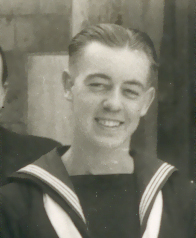
[submitted by Walter’s son Derek Mason]
My father, Walter Mason, was born in Hull. He went to evening classes to study engineering at the Hull Technical College in Park Street near the city centre. It was a five year course. He did well in his studies but did not finish the course because of the outbreak of WW2.
In September 1938 Hitler announced Germany’s intention to march on Czechoslovakia. War with Germany was looking more likely. Three months later Walter joined the Humber Division of the RNVR. He trained at Chatham Barracks and qualified as a member of a four inch AA (anti-aircraft) gun crew.
On 9 December 1939 Walter got engaged to Vera. He gave her a diamond ring and a silver RNVR sweetheart brooch. Walter went to Chatham Barracks on New Year’s Day 1940 and he took his ukelele banjo. He was drafted to HMS Carlisle, a cruiser, and was one of its anti-aircraft gun crew. In February 1940 HMS Carlisle sailed to Malta. There were rough seas and the ship was damaged. Two marines were washed overboard. Walter himself was almost washed overboard but he managed to grab a handrail and hang on. He was extremely lucky and it would not be the last time.
Between 1939 and 1943, Walter was involved in convoy escort duties in the Atlantic and Mediterranean onboard HMS Carlisle and HMS Folkestone on Atlantic and North Africa Convoy
He was drafted to HMS Westcott towards the end of June 1943. The ship was based at Londonderry, Northern Ireland. It was deployed to escort Arctic convoys to Murmansk, Russia, in the Arctic Circle. These convoys were dubbed “the worst journey in the world” by Winston Churchill. The Germans wanted to stop food and armaments reaching Russia or Britain. German U-boat packs patrolled the area between Iceland and the coast of Norway. They picked off and sank many merchant ships. Thousands of merchant seamen lost their lives. It was known as U-boat alley. The journey was susceptible to aircraft attack as it was within range of German airfields. In addition to these dangers the route was notorious because of its very bad weather conditions.
An additional hazard was water constantly freezing on the ship’s exterior surfaces and encrusting the ship in ice. The crew had to use hammers and picks to break the ice off the deck, railings, etcetera. Otherwise the additional weight would make the ship top heavy, and it could keel over. On one occasion Walter was not holding on to a safety line. The ship was rolling and he slipped on the ice. He only just managed to stop himself slipping overboard. Had he gone into the sea he would not have survived the cold. His luck had held again.
One Able Seaman on HMS Westcott recalled that “On the Russian convoys you weren`t allowed to take your clothes off. You lay in your hammock with them on, a week or more at a time, and without being able to have a wash. It was bitterly cold. You got frostbite if you weren`t careful. I saw several men with frostbite. The convoys were dangerous because it would get very dark, only two hours of daylight when you`re right up north. If a gale started up, at say one hundred miles an hour and you wanted to go from the fo’castle to aft on guard, you had to hold on to the life-lines or you would get swept off your feet and over the ship you`d go. There were iron rails which stretched overhead and they had lines that would slip along them and were for you to hold on to. When you went below your trousers would be white from the [frozen] salt water. We had regular parades. We lined up to be counted to make sure we were all still there”.
In October 1943 Westcott sailed to Kola Inlet, near Murmansk, with nineteen warships as part of an operation to bring back merchant ships which had remained in Russia during the summer. Westcott and eight warships helped escort thirteen merchant ships in a convoy named RA54A to Loch Ewe, near Ullapool, north-west Scotland. In December Westcott and ten warships escorted a twenty ship convoy to Murmansk. She returned to Loch Ewe at the end of the month without any loss of the twenty-three ships in that convoy. During that journey half of the warships were ordered to detach and protect a northward bound convoy that was being threatened by the heavily armed and feared German battleship, Scharnhorst. They chased the battleship and sank it on 26 December. The news of the sinking will have been celebrated throughout the British fleet.
Early in January 1944 Walter was granted some leave. He travelled from Glasgow to Hull to see his wife, and to see for the first time his son, Rodney Setchfield Mason, who had been born on 29 October 1943.
Towards the end of January Westcott joined another convoy to Murmansk. It was protected with three destroyers, three minesweepers, and two corvettes. More destroyers joined after a few days. Westcott returned to Loch Ewe with a convoy of thirty-nine merchant ships and ten warships. Both convoys arrived safely. On arrival in mid-February, Walter was given seven days home leave.
Between March and the beginning of May Westcott helped protect two more convoys to Murmansk and also two return convoys to Loch Ewe. The convoys hit atrocious weather in April. After Westcott and its convoy had arrived at Loch Ewe early in May, Walter was ordered to leave the ship and return to Chatham. At the same time he was given a pay rise of five pence per day.
The medals awarded to Walter included the 1939-45 Star, Atlantic Star, Africa Star with a North Africa 1942-43 clasp, Pacific Star, Italy Star and the War Medal 1939-45. In November 1986 a Russian official came to his house to present him with a Russian commemorative medal marking the 40th anniversary of Victory in the Great Patriotic War, 1941-45. He was posthumously awarded the Arctic Star medal in August 2014.
My father spoke to me about his wartime service only on a few occasions. He was particularly fond of HMS Carlisle and its crew. Contrary to navy rules he kept a diary of his activities throughout most of the war. His RNVR experiences and views were recorded for the Imperial War Museum in two taped interviews, which can be listened to online.
https://www.iwm.org.uk/collections/item/object/80011283
Walter’s brother Henry died on HMS Dasher when it blew up and sank near Arran on 27 March 1943. The family received the Arctic Star in his memory from HRH The Princess Royal at a memorial service in March 2026.